

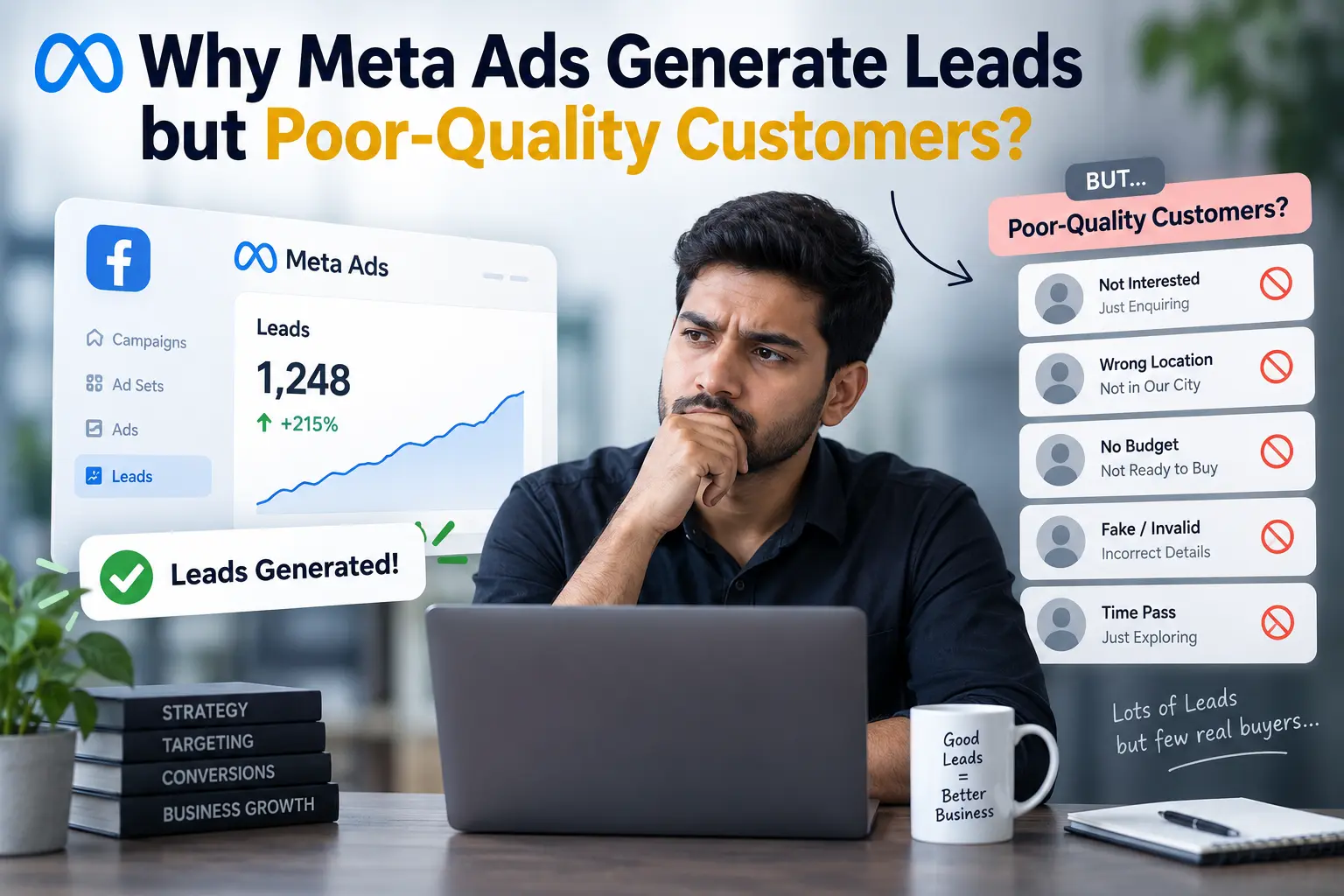
Meta Ads have become one of the most popular ways for businesses to generate leads through Facebook and Instagram. They can help businesses reach thousands of potential customers, generate enquiries, and build a steady sales pipeline.
But there is one common problem many businesses face: “We are getting leads from Meta Ads, but most of them are not converting into customers.”
You may see a low Cost Per Lead (CPL) in your Meta Ads dashboard, but when your sales team starts calling the leads, many may be unreachable, outside your target location, not interested, have a low budget, or may not even remember submitting the form.
So, why does this happen? The answer is that generating leads and generating qualified leads are two different goals. Meta can help you generate a large number of enquiries, but your campaign strategy, targeting, ad creative, lead form, offer, tracking, and follow-up process determine whether those leads are actually valuable.
In this blog, we will explain why Meta Ads generate poor-quality leads, the common mistakes businesses make, and how to improve Meta Ads lead quality.
Get a Lead Generation PlanEternal HighTech Pvt. Ltd.
What Are Poor-Quality Leads?
Before fixing the problem, it is important to understand what a poor-quality lead actually means.
A lead may be considered low quality when the person:
- Provides an incorrect or unreachable phone number
- Is outside your target service area
- Has no genuine interest in your product or service
- Cannot afford your product
- Is only looking for free information
- Does not remember submitting the enquiry
- Is not the actual decision-maker
- Is looking for something different from what you offer
- Has no immediate purchase requirement
- Does not respond to calls or messages
For example, a real estate company promoting apartments starting at ₹90 lakh may generate hundreds of leads through Meta Ads. However, if many leads have a budget of ₹30–40 lakh, the campaign may generate a low CPL but poor business results.
This is why CPL should not be the only metric used to measure Meta Ads performance
Why Do Meta Ads Generate Leads but Poor-Quality Customers?
1. Your Campaign Is Optimized for Lead Volume Instead of Lead Quality
One of the biggest reasons for poor lead quality is the campaign's optimization goal.
If your campaign is designed to maximize the number of leads, Meta's system will try to find people who are more likely to complete the lead form.
But someone who is likely to fill out a form is not necessarily someone who is likely to purchase.
This creates an important difference:
Lead generation ≠ customer generation.
Meta's own lead-generation guidance distinguishes between maximizing lead volume and optimizing for conversion leads when quality data is available.
If your business cares about qualified enquiries, appointments, site visits, demos, or sales, you need to build your campaign around those downstream actions rather than focusing only on the number of forms submitted.
2. Your Audience Targeting Is Too Broad
Another common reason for poor-quality Meta Ads leads is targeting an audience that is too broad.
For example, imagine a business selling premium residential properties in Pune.
Targeting:
- Age: 25–55
- Location: Pune
- Interest: Real Estate
may generate plenty of leads.
But the audience could include:
- People who are only casually interested in property
- Students and young professionals
- People with budgets below the property's price range
- People looking for rental properties
- People looking for properties in another city
- People who are only researching the market
The campaign may generate leads, but not necessarily qualified property buyers.
The solution is not always to make your audience extremely narrow. Instead, your audience strategy should be based on your actual customer profile, campaign data, location, product price, buying behavior, and conversion history.
3. Your Ad Creative Attracts the Wrong Audience
Your targeting isn't the only thing that determines who responds to your Meta Ads.
Your ad creative acts as a filter.
If your advertisement says:
“Get a FREE Consultation Today!”
you may attract people who are interested in getting something free.
But if your actual service is a premium solution costing ₹50,000 or ₹1 lakh, the people attracted by the "free" offer may not be your ideal customers.
Instead, your creative should communicate:
- What you offer
- Who it is for
- The key benefit
- Relevant pricing information when appropriate
- Location or service area
- The problem you solve
- A clear call to action
The more accurately your ad communicates your offer, the better chance you have of attracting people who are genuinely interested.
4. Your Lead Form Has Too Little Qualification
Instant Forms make it extremely easy for users to submit their details without leaving Facebook or Instagram.
This is one of their biggest advantages. But the same low-friction experience can also make it easier for people with low intent to submit a form. Meta's lead-generation guidance recommends using appropriate form types and qualifying information while avoiding unnecessary complexity.
Instead of asking only:
- Name
- Phone Number
consider adding relevant qualifying questions.
For example:
For Real Estate
What is your preferred budget?
- ₹50–75 Lakh
- ₹75 Lakh–₹1 Cr
- ₹1–1.5 Cr
- ₹1.5 Cr+
For Website Development
What type of website do you need?
- Business Website
- E-commerce Website
- Custom Web Application
- Website Redesign
For Digital Marketing
What is your monthly marketing budget?
- ₹20,000–₹50,000
- ₹50,000–₹1 Lakh
- ₹1–3 Lakh
- ₹3 Lakh+
These questions introduce qualification into the lead-generation process.
The goal isn't to make the form unnecessarily long. It is to collect enough information to determine whether the lead matches your ideal customer profile.
5. Your Offer and Your Actual Product Do Not Match
This is one of the most overlooked reasons for poor lead quality.
Imagine an advertisement says:
“Get Your Dream Home Starting at ₹50 Lakh.”
A person submits the form expecting a ₹50 lakh property.
But when the sales team contacts them, the available property starts at ₹90 lakh.
The problem isn't necessarily the lead.
The problem is expectation mismatch.
The same happens with services.
If an agency advertises:
“Get a Website Starting at ₹5,000”
but the sales team later recommends a ₹50,000 custom website, many leads may lose interest.
Your: Ad → Landing Page/Form → Sales Conversation → Product should communicate a consistent offer.
6. Your Location Targeting Is Not Aligned With Your Business
Location can have a major impact on lead quality, particularly for local businesses and real estate companies.
For example, a property developer selling apartments in Pune may want enquiries from specific areas around the project. If the campaign reaches people who are outside the company's serviceable market, the campaign can generate enquiries that are technically valid leads but commercially useless.
Businesses should regularly check:
- Lead location
- Serviceable areas
- Customer location
- Campaign location settings
- Excluded locations
- Actual sales conversion by location
Don't judge location performance only by CPL.
A location generating a ₹200 CPL may be worse than another location generating a ₹500 CPL if the ₹500 leads convert into customers.
7. Your Sales Team Is Not Following Up Quickly
Sometimes the problem isn't the Meta Ads campaign.
It is the follow-up process.
A lead may be genuinely interested when they submit the form. But if the business contacts them several hours later—or the next day—their interest may have decreased.
A good lead-generation system should connect Meta Ads with your CRM or lead-management system so that sales teams can receive and act on new leads quickly.
Meta also recommends CRM integration and the use of Conversions API to share lead outcomes and improve optimization toward leads more likely to convert.
A simple process could be:
Meta Ad → Lead Form → CRM → Sales Team → Immediate Follow-Up → Qualification → Appointment/Site Visit → Sale
The faster and more structured this process is, the easier it becomes to identify which leads are actually valuable.
8. You Are Measuring CPL Instead of Cost Per Customer
This is perhaps the biggest mistake businesses make.
Suppose:
Campaign A
- 100 leads
- ₹200 CPL
- 2 customers
- Total ad spend = ₹20,000
Campaign B
- 40 leads
- ₹500 CPL
- 8 customers
- Total ad spend = ₹20,000
Campaign A looks better if you only look at CPL.
But Campaign B is clearly better for the business.
This is why businesses should track metrics such as:
- Cost Per Lead
- Qualified Lead Rate
- Cost Per Qualified Lead
- Contact Rate
- Appointment Rate
- Site Visit Rate
- Sales Conversion Rate
- Customer Acquisition Cost
- Revenue Generated
- Return on Ad Spend
The cheapest lead is not always the most valuable lead.
9. Your Campaign Does Not Feed Quality Data Back to Meta
Meta's algorithm needs useful signals to improve campaign performance.
If Meta only receives the information:
“This person submitted a form.”
it has limited information about whether that person eventually became a customer.
But if your systems can connect lead data with downstream actions such as qualified leads, appointments, or conversions, you can provide stronger signals for optimization.
Meta supports CRM integration and Conversions API-based workflows for sharing lead and conversion information.
This creates a better feedback loop:
Ad → Lead → Qualified Lead → Appointment → Customer → Data → Meta Optimization
Over time, this can help your campaign move beyond simply finding people who submit forms
10. Your Creative Strategy Is Not Being Tested
A single creative should not be expected to work forever.
Different audiences respond to different:
- Hooks
- Headlines
- Offers
- Images
- Videos
- Benefits
- Calls to action
- Formats
For example, instead of running only:
“Get the Best Digital Marketing Services.”
test different angles:
Problem-Based
Not Getting Quality Leads From Your Ads?
Benefit-Based
Generate More Qualified Leads With Performance Marketing
Cost-Based
Reduce Wasted Ad Spend With Better Lead Targeting
Industry-Based
Generate More Property Enquiries With Meta Ads
The objective is not simply to find the creative with the highest number of leads. Find the creative that generates the highest-quality leads at an acceptable cost.
How to Improve Lead Quality From Meta Ads
If your business is getting poor-quality leads, use the following framework.
Step 1: Define Your Ideal Customer
Before changing the campaign, clearly define:
- Location
- Age group
- Profession
- Budget
- Buying requirement
- Decision-making authority
- Product/service req
Step 2: Review Your Existing Leads
Don't make changes based only on assumptions. Analyze your previous leads and identify patterns.
Ask:
- Where are the good leads coming from?
- Where are the bad leads coming from?
- Which age groups convert better?
- Which locations generate customers?
- Which creatives generate qualified enquiries?
- Which questions help identify serious prospects?
This data should guide your optimization.
Step 3: Add Relevant Qualification Questions
Use questions that help identify genuine prospects.
Examples:
- What is your budget?
- Which service are you interested in?
- When are you planning to purchase?
- Which location are you looking for?
- What is your business size?
- Are you the decision-maker?
- When would you like to get started?
Avoid adding unnecessary questions simply to make the form longer. The goal is meaningful qualification, not maximum friction.
Step 4: Improve Your Ad Messaging
Be transparent about your:
- Product
- Pricing range
- Location
- Key features
- Eligibility
- Service
- Expected outcome
This helps discourage people who are clearly not a fit.
Step 5: Test Instant Forms Against Landing Pages
There is no universal rule that landing pages are always better than Instant Forms. Both can work depending on the business and campaign.
Instant Forms provide a fast, low-friction experience, while landing pages can provide more information and additional qualification before submission.
Current lead-generation guidance supports testing both approaches based on the campaign objective and conversion setup.
For high-ticket products or services, a landing page can be particularly useful when customers need more information before enquiring.
Step 6: Connect Your CRM
Your marketing team should know what happens to a lead after submission.
Connect your:
Meta Ads → CRM → Sales → Conversion Data
This makes it easier to measure the real business impact of your advertising.
Step 7: Optimize for Business Results
Don't ask: “How many leads did we generate?”
Ask: “How many qualified leads did we generate?”
Then:
“How many became customers?”
And finally:
“How much revenue did those customers generate?”
That's the difference between simply running ads and running performance marketing focused on business growth.
Meta Ads Lead Quality Checklist
Before launching your next campaign, check:
- ☑ Is the target audience clearly defined?
- ☑ Is the location correct?
- ☑ Does the creative clearly communicate the offer?
- ☑ Is the pricing/starting price clear when appropriate?
- ☑ Are relevant qualifying questions included?
- ☑ Is the lead form optimized for quality?
- ☑ Is the CRM connected?
- ☑ Is the sales team following up quickly?
- ☑ Are qualified leads being tracked separately?
- ☑ Are you measuring cost per qualified lead?
- ☑ Are you tracking appointments and sales?
- ☑ Are you testing different creatives?
- ☑ Are you optimizing based on actual conversion data?
Final Thoughts
Meta Ads are not necessarily generating poor-quality leads because the platform doesn't work. In many cases, the real issue is the campaign strategy.
If your campaign focuses only on generating the maximum number of leads at the lowest possible CPL, you may end up optimizing for quantity rather than business value.
A successful Meta Ads strategy combines:
Right Audience + Right Creative + Right Offer + Qualified Lead Form + Fast Follow-Up + CRM Data + Conversion Tracking
The goal should not be:
“Get more leads.”
The goal should be:
“Get more of the right leads that can become customers.”
At Eternal HighTech, performance marketing is about looking beyond clicks and lead counts and focusing on the metrics that actually matter to business growth—qualified leads, conversions, and measurable results.
If your Meta Ads are generating leads but those leads are not converting, it may be time to review your audience targeting, ad creatives, lead form, conversion tracking, and overall lead-generation funnel instead of simply increasing your advertising budget.
Want to generate better-quality leads from Meta Ads?
Talk to the Eternal HighTech team to build a data-driven lead generation strategy for your business.
Contact:
Phone: +919028718877
Email: contact@eternalhightech.com
Website: https://eternalhightech.com
