

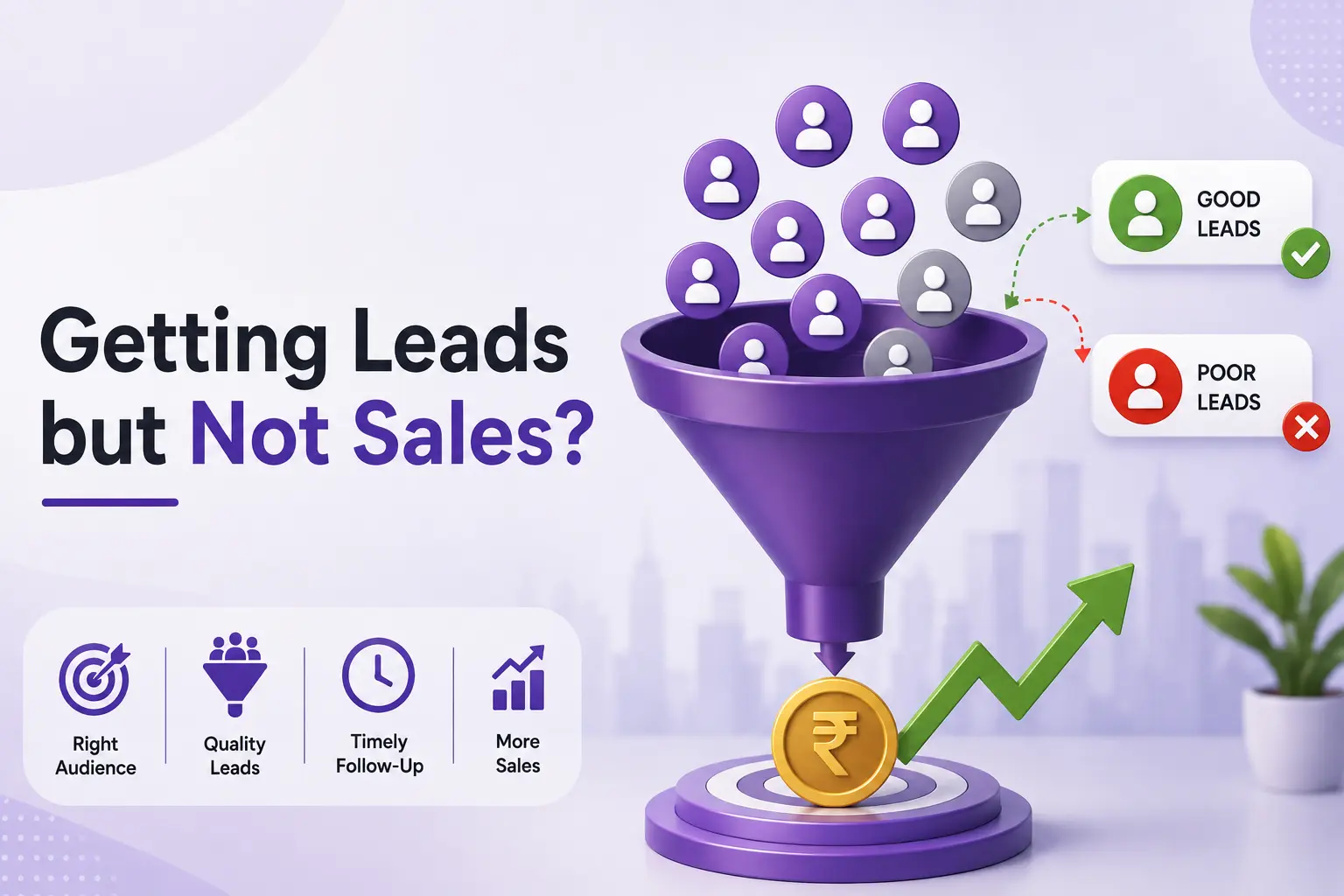
Your business is investing in digital marketing, running Google Ads, Meta Ads, SEO campaigns or lead generation campaigns. The leads are coming in, but there is one major problem, they are not converting into sales.
This is one of the most common lead generation problems faced by businesses. A high number of leads does not always mean a successful marketing campaign.
If people are filling out your forms but are not answering calls, are not interested in your product, cannot afford your pricing or are outside your target market, you may be dealing with poor lead quality.
The real goal of digital marketing is not simply to generate more leads. It is to generate relevant, qualified and high-quality leads that have a genuine potential to become customers. In this blog, we explore 10 reasons why your business is getting leads but not sales and practical ways to improve lead quality and increase conversions.
Get a Lead Generation PlanEternal HighTech Pvt. Ltd.
1. You Are Targeting the Wrong Audience
One of the biggest reasons behind poor lead quality is incorrect audience targeting.
If your ads are reaching people who are not likely to need, afford or purchase your product or service, you may receive a large number of inquiries but very few sales.
For example, a premium real estate project targeting a broad audience may generate leads from people who are only casually exploring properties or whose budget does not match the project.
How to improve lead quality:
- Define your ideal customer profile (ICP)
- Target relevant locations
- Consider customer budget and purchasing capacity
- Use relevant interests and behaviours
- Test broad and targeted audiences separately
- Exclude irrelevant audience segments where possible
Better targeting can help reduce unnecessary enquiries and improve the percentage of qualified leads.
2. Your Lead Form Is Too Easy to Fill
A simple form can increase the number of leads, but it can also attract low-intent users.
For example, if your form only asks for a name and phone number, almost anyone can submit it without showing genuine interest.
This can create the illusion of successful lead generation, while your sales team receives a large number of irrelevant leads.
How to improve lead quality:
Add qualifying questions such as:
- What is your budget?
- When are you planning to purchase?
- Which product or service are you interested in?
- What is your preferred location?
- What is your business size?
- When would you like to get started?
The right questions can help your business identify serious prospects before your sales team spends time following up.
3. Your Ad Message Is Attracting the Wrong People
Your advertisement may be generating clicks and leads because of an attractive offer, but the message may not accurately explain what you are selling.
For example, using phrases such as “Starting at ₹XXX”, “Free Consultation” or “Limited Offer” can attract a wide audience. If important information such as pricing, location, eligibility or service details is unclear, users may submit their details without understanding the actual offering.
When the sales team contacts them, they may lose interest.
How to improve lead quality:
Make your advertisements clear about:
- Product or service
- Starting price or investment range, where appropriate
- Target location
- Key requirements
- Who the offer is suitable for
- Expected next step
Clear messaging can reduce misleading enquiries and attract more relevant prospects.
4. There Is a Gap Between Your Ad and Landing Page
Your advertisement may promise one thing, while your landing page gives users different information.
This creates confusion and can reduce trust.
For example, if an ad promotes a specific offer but the landing page focuses on general company information, visitors may not clearly understand what they need to do next.
This is a common reason why businesses experience lead generation problems and low conversion rates.
How to improve lead quality:
Ensure that your ad and landing page have:
- A consistent offer
- Similar messaging
- Clear pricing or relevant details
- Strong benefits
- A clear call-to-action
- A simple conversion path
The user should immediately understand that they have landed in the right place.
5. You Are Optimising Campaigns for Quantity Instead of Quality
Many businesses focus heavily on metrics such as:
- Cost per lead (CPL)
- Number of leads
- Click-through rate (CTR)
These metrics are important, but they do not tell the complete story.
A campaign generating 100 leads at ₹100 each is not necessarily better than a campaign generating 30 highly qualified leads at ₹300 each.
If only one of the 100 leads becomes a customer while five of the 30 qualified leads convert, the second campaign may deliver significantly better business results.
How to improve lead quality:
Track metrics such as:
- Qualified lead rate
- Contact rate
- Appointment or demo booking rate
- Site visit rate
- Sales conversion rate
- Cost per qualified lead
- Cost per acquisition (CPA)
The focus should be on business outcomes, not just cheap leads.
6. Your Sales Team Is Following Up Too Late
Even a high-quality lead can become cold if your business takes too long to respond.
When someone submits an enquiry, they are usually showing interest at that particular moment.
If the first follow-up happens several hours or days later, the prospect may have already contacted a competitor or lost interest.
Slow response time can make it appear that the campaign is generating poor leads when the real issue is the follow-up process.
How to improve lead conversion:
- Contact leads as quickly as possible
- Set up instant lead notifications
- Use CRM automation
- Create a structured follow-up process
- Make multiple follow-up attempts when appropriate
- Track every interaction
Fast and consistent follow-up is essential for converting marketing leads into sales opportunities.
7. Your Sales and Marketing Teams Are Not Aligned
Marketing may define a successful lead differently from the sales team.
For example, the marketing team may consider every form submission a lead. However, the sales team may only consider someone qualified if they have the required budget, location and purchase intent.
Without a common definition, the sales team may complain about poor lead quality while the marketing team sees strong campaign results.
How to solve this:
Create a clear definition of a qualified lead.
Both teams should agree on factors such as:
- Target customer profile
- Budget
- Location
- Purchase timeline
- Business requirements
- Decision-making authority
- Level of interest
This feedback should then be shared regularly to improve campaign targeting.
8. Your Offer Is Not Strong Enough
Sometimes the problem is not the campaign or the leads, it is the offer.
Potential customers may show initial interest, submit their details and then decide that the product, price or value proposition does not meet their expectations.
If competitors offer clearer benefits, better pricing, stronger trust signals or a better customer experience, leads may not move forward.
How to improve:
Review your:
- Pricing strategy
- Unique selling proposition (USP)
- Competitor positioning
- Offers and incentives
- Customer reviews and testimonials
- Case studies
- Guarantees or trust signals
Your marketing should clearly answer one important question:
Why should a potential customer choose your business over another option?
9. You Are Not Tracking Which Leads Actually Convert
Without proper tracking, businesses often make decisions based only on the number of leads generated.
But if you do not know:
- Which campaign generated the sale
- Which audience produced qualified leads
- Which keyword generated high-intent enquiries
- Which ad attracted serious buyers
…it becomes difficult to improve lead quality.
How to improve lead tracking:
Connect your marketing and sales data wherever possible.
Use tools such as:
- CRM systems
- Lead status tracking
- Google Ads conversion tracking
- Meta Pixel and Conversions API
- Call tracking
- Offline conversion tracking
Regularly analyse which campaigns generate revenue, not just leads.
10. You Are Not Nurturing Leads Properly
Not every potential customer is ready to buy immediately.
Some leads may be genuinely interested but are still researching, comparing options or waiting for the right time.
If your business contacts them only once and then marks them as a poor-quality lead, you could be losing future customers.
How to improve lead nurturing:
Create a structured nurturing strategy using:
- Follow-up calls
- WhatsApp communication
- Email campaigns
- Retargeting ads
- Educational content
- Case studies
- Testimonials
- Special offers
Lead nurturing helps your business stay connected until the prospect is ready to make a decision.
How to Improve Lead Quality and Generate More Sales
If your business is getting leads but not sales, do not immediately assume that your marketing campaign has failed.
Analyse the complete customer journey:
Targeting → Ad → Landing Page/Form → Lead Qualification → Follow-Up → Sales Process → Conversion
A problem at any stage can affect your final sales results.
At Eternal HighTech, the focus should not only be on generating a high volume of enquiries. A strong digital marketing strategy should focus on reaching the right audience, improving campaign quality, qualifying prospects and tracking the complete journey from lead to sale.
The goal is simple: Generate fewer irrelevant leads and more meaningful business opportunities.
By continuously analysing campaign data, sales feedback and lead behaviour, businesses can identify the real reasons behind poor lead quality and make smarter marketing decisions.
Final Thoughts
Getting a large number of leads is not the same as building a successful lead generation strategy.
If you are experiencing poor lead quality, the solution may involve improving your audience targeting, ad messaging, lead forms, landing pages, tracking or sales follow-up process.
The best approach is to measure the complete funnel and focus on metrics that actually impact business growth—such as qualified leads, appointments, opportunities, customers and revenue.
If your business is struggling with lead generation problems or getting leads but not sales, a data-driven strategy can help identify where leads are dropping off and improve the quality of future enquiries.
Need help generating high-quality leads for your business?
Eternal HighTech helps businesses build data-driven digital marketing and lead generation strategies focused on better-quality prospects and measurable business growth.
Contact:
Phone: +919028718877
Email: contact@eternalhightech.com
Website: https://eternalhightech.com
